
Sleep Research
DSIP 5mg
$79.00

In stock
Glutathione (also known as GSH or by its chemical name γ-L-Glutamyl-L-cysteinyl-glycine) is a tripeptide composed of three amino acids — glutamic acid, cysteine, and glycine — joined through an unusual gamma-carboxyl peptide bond between glutamic acid and cysteine. It is the most abundant low-molecular-weight thiol in human cells and one of the most important endogenous antioxidants in human biology. Glutathione plays central roles in cellular redox homeostasis, detoxification of xenobiotics and reactive oxygen species, immune function, and protein function. Cellular glutathione levels decline with age, with chronic disease, and under conditions of oxidative stress — making the compound a major focus in research into aging biology, hepatic detoxification, and oxidative stress-related conditions.
It is sold for laboratory and analytical research only and is not approved by the U.S. Food and Drug Administration for any therapeutic indication.
Glutathione is a tripeptide with the unusual structural feature of containing a gamma-glutamyl peptide bond — meaning the glutamic acid is connected to cysteine through its gamma-carboxyl group rather than the standard alpha-carboxyl group used in conventional peptide bonds. The full name is γ-L-Glutamyl-L-cysteinyl-glycine, with chemical formula C10H17N3O6S and molecular weight of approximately 307.3 Daltons. The reduced form (GSH) contains a free sulfhydryl group on the cysteine residue; the oxidized form (GSSG, glutathione disulfide) contains two glutathione molecules joined by a disulfide bond between their cysteine residues.
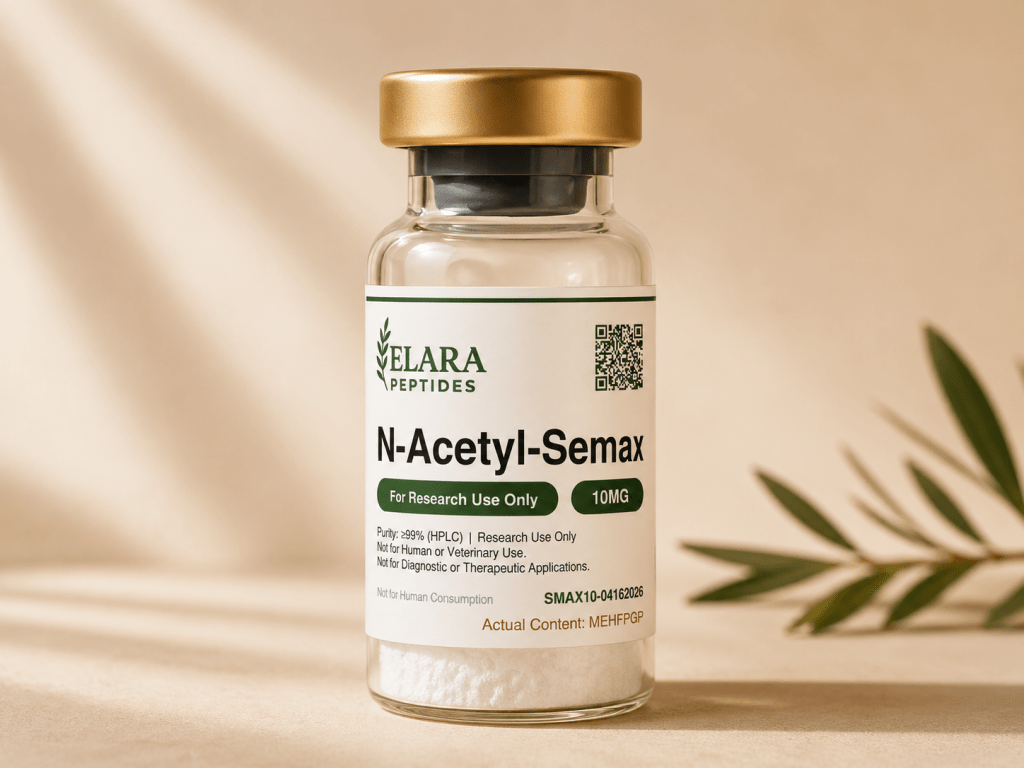
The reduced (GSH) and oxidized (GSSG) forms exist in dynamic equilibrium in human cells, with the GSH:GSSG ratio serving as a sensitive indicator of cellular redox status. Healthy cells typically maintain GSH:GSSG ratios of 100:1 or higher; oxidative stress shifts this ratio toward GSSG. The "Actual Content: ECG" notation on the product label refers to the single-letter amino acid abbreviations (E=Glu, C=Cys, G=Gly) of the tripeptide composition.
The lyophilized (freeze-dried) form supplied for research is stable at -20°C for up to 24 months when sealed and protected from moisture. Glutathione is more chemically labile than typical peptides due to the reactive sulfhydryl group, and is sensitive to oxidation. Following reconstitution with bacteriostatic water, the compound retains research-grade integrity for approximately 30 days when refrigerated at 2–8°C and protected from light and air. Repeated freeze-thaw cycles and prolonged exposure to oxygen should be avoided to maintain experimental reproducibility.
Glutathione functions as a master regulator across multiple cellular systems. Its biological roles span antioxidant defense, detoxification, immune function, and protein structure modulation — making it one of the most pleiotropic small molecules in human biology.
Antioxidant defense and reactive oxygen species detoxification. Glutathione is the substrate for glutathione peroxidase, a family of enzymes that reduce hydrogen peroxide and lipid hydroperoxides — the primary reactive oxygen species generated as byproducts of cellular metabolism. The reaction oxidizes GSH to GSSG, which is then reduced back to GSH by glutathione reductase using NADPH. This cycle represents one of the primary cellular antioxidant defense systems and is central to cellular protection against oxidative damage.
Phase II detoxification reactions. Glutathione is the cofactor for glutathione S-transferases (GSTs), a family of enzymes that conjugate glutathione to xenobiotic compounds and electrophilic metabolites — making them more water-soluble and facilitating excretion. Phase II glutathione conjugation is a primary detoxification pathway for environmental toxins, drug metabolites, and endogenous reactive metabolites. The liver, with its high concentration of GSTs and high glutathione synthesis capacity, is the primary site of these detoxification reactions in human physiology.
Acetaminophen toxicity and N-acetylcysteine clinical relevance. Acetaminophen (paracetamol) overdose is the most common cause of acute liver failure in the United States, with mechanism involving glutathione depletion by toxic acetaminophen metabolites. N-acetylcysteine — a glutathione precursor used clinically — is the established antidote for acetaminophen toxicity, demonstrating direct human therapeutic relevance of glutathione biology.
Immune function. Glutathione plays multiple roles in immune cell function, including regulation of T-cell activation, modulation of cytokine production, and maintenance of immune cell redox homeostasis. Glutathione depletion has been linked to immune dysfunction in human aging, HIV infection, and chronic disease contexts.
Protein function and S-glutathionylation. Glutathione modifies cysteine residues on many cellular proteins through S-glutathionylation — a reversible post-translational modification that regulates protein activity and stability. S-glutathionylation is increasingly recognized as a major regulatory mechanism in human cellular biology, affecting metabolic enzymes, signaling proteins, and transcription factors.
Mitochondrial function. Mitochondria contain their own glutathione pool that protects against oxidative damage from electron transport chain byproducts. Mitochondrial glutathione decline is implicated in age-related mitochondrial dysfunction across human tissues.
Hepatic biology. The liver is the primary site of glutathione synthesis in the body and the primary site of glutathione-mediated detoxification. Liver glutathione status is a major determinant of hepatic resilience against drug-induced injury, oxidative damage, and chronic liver disease progression.
Glutathione has one of the most extensive research portfolios of any biological molecule, with substantial human clinical research across multiple application areas.
Hepatic clinical applications. N-acetylcysteine, a glutathione precursor that elevates cellular glutathione levels, is FDA-approved for acetaminophen overdose and is used clinically in chronic liver disease management. Direct glutathione administration has been studied in human clinical contexts including liver disease, with various routes of administration examined.
Aging and oxidative stress research. Multiple human studies have documented age-related decline in cellular glutathione levels and its association with multiple age-related conditions. Research has examined whether glutathione supplementation through various approaches (oral GSH, liposomal formulations, NAC, glycine plus NAC combinations) can restore tissue glutathione levels and ameliorate aging-related dysfunction.
Neurological research. Glutathione has been studied in Parkinson's disease, where reduced brain glutathione levels are a documented feature. Research has examined glutathione administration in Parkinson's patients with mixed but interesting results, and the broader role of brain glutathione in neurodegeneration is an active area of human clinical research.
Cardiovascular research. Glutathione levels have been studied in cardiovascular disease, where oxidative stress is a contributing factor. Research has examined glutathione status as a biomarker and as a potential therapeutic target.
Translational research areas with substantial human clinical relevance:
Every batch of Glutathione supplied by Elara is independently analyzed by a third-party laboratory before release. Our Certificate of Analysis documents two distinct verification measures:
HPLC purity (≥99%). High-performance liquid chromatography separates reduced glutathione (GSH) from oxidized glutathione (GSSG) and other related species. Our specification requires a minimum 99% purity at the main peak, with the supplied compound predominantly in the reduced (GSH) form. Glutathione is sensitive to oxidation, and HPLC verification confirms the supplied compound has not undergone significant oxidation during synthesis or storage.
Mass spectrometry identity confirmation. MS analysis confirms that the molecular weight of the peak compound matches the theoretical molecular weight of glutathione (~307.3 Da for GSH; ~612.6 Da would indicate GSSG). The mass signature distinguishes the reduced active form from the oxidized form and confirms the correct gamma-glutamyl peptide bond structure characteristic of glutathione.
The COA accompanies every shipment and is also available for download on this product page.
For laboratory research applications, Glutathione is typically reconstituted using bacteriostatic water (0.9% benzyl alcohol). Standard practice involves slow addition of solvent along the inside wall of the vial — never directly onto the lyophilized powder, which can cause aggregation. The vial is then gently swirled (not shaken or vortexed) until fully dissolved.
Glutathione is more sensitive to oxidation than peptide compounds with disulfide bonds in a stable folded structure. Once reconstituted, the solution should be stored at 2–8°C, protected from light, and used within 30 days for optimal molecular integrity. Researchers should minimize exposure to atmospheric oxygen during handling — solutions can be kept under nitrogen or argon for longer experimental work where reduced GSH form is critical. Sterile technique is essential during all handling steps. Researchers performing in vitro work or animal model studies should refer to their institution's IACUC protocols and standard handling guidelines specific to their experimental design.
What is glutathione?
Glutathione (GSH) is a tripeptide composed of glutamic acid, cysteine, and glycine, joined through an unusual gamma-carboxyl peptide bond. It is the most abundant low-molecular-weight thiol in human cells and one of the most important endogenous antioxidants in human biology, with central roles in cellular redox homeostasis, detoxification, and immune function.
What does ECG mean on the label?
ECG is the single-letter amino acid abbreviation for glutathione's tripeptide composition: Glutamic acid (E), Cysteine (C), Glycine (G). The "Actual Content: ECG" notation provides the chemical identity of the supplied compound for verification by researchers familiar with the molecule.
What's the difference between GSH and GSSG?
GSH is the reduced (active) form of glutathione, containing a free sulfhydryl (-SH) group on the cysteine residue. GSSG (glutathione disulfide) is the oxidized form, consisting of two glutathione molecules joined by a disulfide bond between their cysteine residues. The two forms exist in dynamic equilibrium in cells, and the GSH:GSSG ratio is a sensitive indicator of cellular redox status. The Elara product is supplied as reduced GSH.
How is glutathione different from N-acetylcysteine (NAC)?
N-acetylcysteine (NAC) is a precursor to glutathione synthesis — it provides cysteine, which is the rate-limiting amino acid for cellular glutathione production. Glutathione itself is the active tripeptide. NAC has the practical advantage of being more orally bioavailable than direct glutathione (which has limited oral bioavailability due to digestive degradation), but glutathione has the advantage of being the biologically active compound directly.
Has glutathione been studied in humans?
Extensively. Glutathione is one of the most studied compounds in human biology, with applications spanning aging research, hepatic protection, neurodegenerative disease, oxidative stress conditions, and immune function. N-acetylcysteine is FDA-approved for acetaminophen overdose, demonstrating clinical relevance of the glutathione system. Direct glutathione administration has been studied in various clinical contexts with mixed but interesting results.
What does HPLC ≥99% purity actually mean for glutathione?
HPLC ≥99% purity means at least 99% of the integrated UV-detectable peak area corresponds to the target compound. For glutathione specifically, this includes verification that the supplied compound is predominantly the reduced (GSH) form rather than the oxidized (GSSG) form. Glutathione is sensitive to oxidation, and rigorous purity verification confirms the supplied compound retains the active reduced form.
How long is glutathione stable after reconstitution?
Reconstituted glutathione retains research-grade integrity for approximately 30 days when stored refrigerated at 2–8°C and protected from light and air. Avoid freeze-thaw cycles. Glutathione is more sensitive to oxidation than typical peptides, so minimizing atmospheric oxygen exposure during handling is important. Lyophilized (unreconstituted) glutathione is stable at -20°C for up to 24 months when properly sealed.
What human pathways does glutathione research target?
The most-studied pathways with direct human clinical relevance include cellular antioxidant defense (glutathione peroxidase system), Phase II detoxification (glutathione S-transferase reactions), hepatic protection biology, immune cell function, mitochondrial protection, S-glutathionylation as a regulatory post-translational modification, and broader research into oxidative stress in aging and chronic disease.
Does Elara test every batch?
Yes. Every production batch of Glutathione receives independent third-party HPLC and mass spectrometry analysis before release. Batches that do not meet our 99% purity specification — including verification that the supplied compound is predominantly the reduced (GSH) form — are rejected. The COA documenting analytical results for the specific batch you receive is included with every shipment and available for download above.
| Purity | =99% (HPLC verified) |
| Form | Lyophilized (freeze-dried) powder |
| Testing | Independent HPLC, mass spectrometry, endotoxin |
| Documentation | Batch-matched Certificate of Analysis |
| SKU | GLUTA |
Proper storage is essential to maintain peptide integrity and maximize shelf life. Follow these guidelines for best results in your research workflow.
15% off · first order
Get 15% off your first order, plus batch notes and new-compound releases. No noise.
Research use only. Unsubscribe anytime.
You're in
Also sent to your inbox. Apply it at checkout.
WELCOME15
Reviews
There are no reviews yet.