
Metabolic Research
SLU-PP-332 5mg
$149.00
In stock
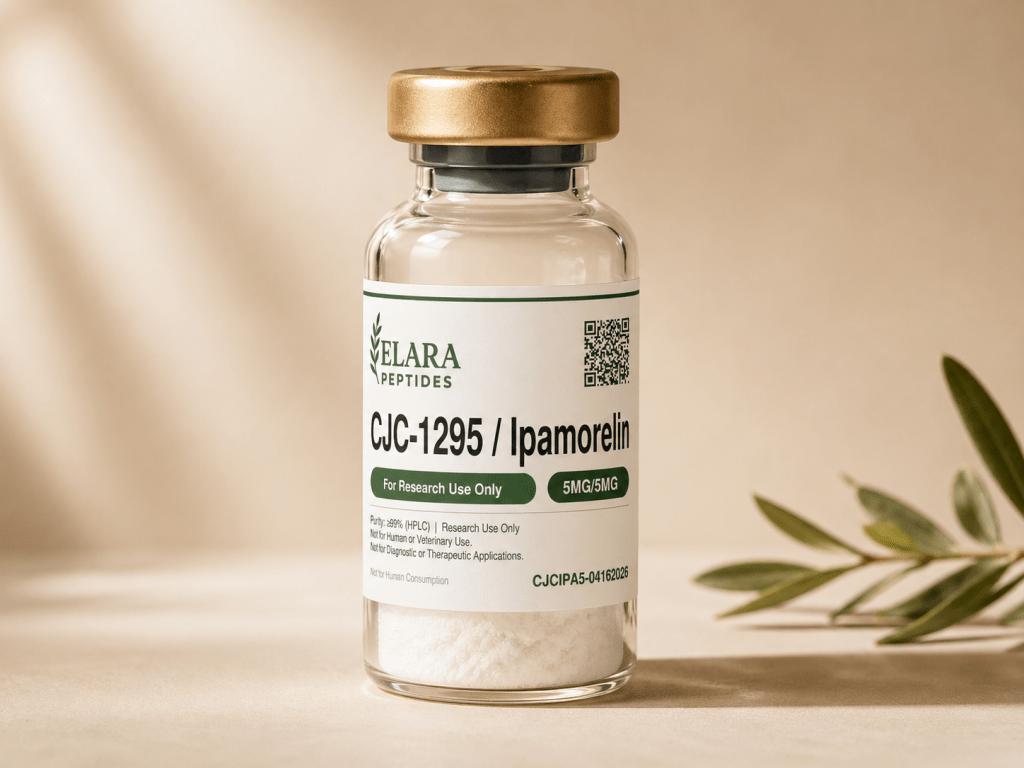
The CJC-1295 / Ipamorelin combination is a research peptide stack pairing two distinct compounds that together target the human growth hormone (GH) axis through complementary mechanisms. CJC-1295 is a synthetic analog of growth hormone-releasing hormone (GHRH) modified for extended plasma stability, and Ipamorelin is a selective ghrelin receptor agonist (also known as a GHS — growth hormone secretagogue). The combination is one of the most extensively studied research peptide stacks in modern endocrinology research, used to study how simultaneous activation of the GHRH and ghrelin receptor pathways modulates pulsatile GH release in human physiology. Each vial supplied by Elara contains 5mg of CJC-1295 and 5mg of Ipamorelin in lyophilized form.
It is sold for laboratory and analytical research only and is not approved by the U.S. Food and Drug Administration for any therapeutic indication.
Growth hormone secretion in human physiology is regulated by two opposing inputs from the hypothalamus: GHRH (which stimulates GH release) and somatostatin (which inhibits GH release). A third input — ghrelin and the ghrelin receptor (GHS-R) — provides an independent stimulatory pathway that operates partly through the hypothalamus and partly through direct effects on the pituitary somatotroph cells that produce GH. Research has documented that combining a GHRH analog with a ghrelin receptor agonist produces additive (and in some studies, synergistic) effects on GH release compared to either compound alone — a finding central to the research interest in this stack.
CJC-1295's pathway — GHRH receptor agonism. CJC-1295 is a synthetic 30-amino-acid analog of GHRH (sermorelin's parent peptide) with four modifications that resist degradation by the enzyme dipeptidyl peptidase-4 (DPP-4). It binds the GHRH receptor on pituitary somatotrophs and stimulates GH production and release through the same receptor system that endogenous GHRH activates. The DPP-4-resistant modifications extend its biological half-life substantially compared to native GHRH. Note: there are two distinct compounds sometimes referred to as "CJC-1295" — one with a Drug Affinity Complex (DAC) extending half-life to roughly 8 days, and one without DAC (sometimes called Mod-GRF 1-29) with a much shorter half-life of around 30 minutes. Researchers should confirm which variant is supplied for their specific protocol.
Ipamorelin's pathway — Ghrelin receptor (GHS-R) agonism. Ipamorelin is a synthetic five-amino-acid pentapeptide that selectively activates the ghrelin receptor without significantly affecting cortisol, prolactin, or other hormones modulated by less selective GH secretagogues. The selectivity is the key pharmacological distinction — earlier GH secretagogues (including GHRP-6 and to some extent GHRP-2) elevated cortisol and prolactin in human studies, while Ipamorelin demonstrated cleaner GH selectivity in published research. This selectivity makes it the preferred ghrelin receptor agonist in research protocols where minimizing off-target endocrine effects is important.
The combined mechanistic hypothesis. CJC-1295 increases the amplitude of pituitary GH pulses through GHRH receptor activation, while Ipamorelin increases the frequency and magnitude of GH release through the parallel ghrelin receptor pathway. The combination has been studied for whether it produces a more robust, more physiological pattern of GH elevation than either compound alone — relevant to research questions about how to mimic natural pulsatile GH secretion versus the steady-state elevation produced by exogenous GH administration.
CJC-1295 was developed by ConjuChem in the early 2000s. Its parent peptide, GHRH (1-29), is the bioactive fragment of native human GHRH responsible for stimulating GH release. The four DPP-4-resistant modifications in CJC-1295 (D-Ala at position 2, Gln at position 8, Ala at position 15, and Leu at position 27) protect against the rapid enzymatic degradation that limits native GHRH and earlier GHRH analogs to clinical irrelevance.
Research has documented CJC-1295-associated effects on:
Ipamorelin (sequence: Aib-His-D-2-Nal-D-Phe-Lys-NH2) was developed by Novo Nordisk in the 1990s and was specifically engineered for selectivity at the ghrelin receptor. It is a five-amino-acid pentapeptide with non-natural amino acids (D-amino acid stereoisomers and a non-standard residue) that confer selective binding without the off-target effects observed with earlier compounds in the GHS class.
Research has documented Ipamorelin-associated effects on:
The combined CJC-1295 / Ipamorelin stack and its individual components have been examined across several human-relevant research domains:
Adult growth hormone deficiency (AGHD). AGHD affects an estimated 1 in 100,000 adults annually with documented effects on body composition, exercise capacity, lipid profiles, bone density, and quality of life. Conventional treatment uses recombinant human growth hormone, which provides constant rather than pulsatile elevation. GHRH and ghrelin receptor research compounds have been studied as alternative approaches that preserve more physiological pulsatility patterns.
Age-related decline in GH/IGF-1 axis. The somatopause — age-related decline in GH and IGF-1 — has been linked to changes in body composition, bone density, and metabolic function in elderly populations. Research has examined whether modest restoration of GH/IGF-1 axis activity through secretagogue compounds could address aspects of this decline without the pharmacological complexity of full hGH replacement.
Sleep and recovery research. GH is preferentially released during slow-wave sleep, and research has examined how secretagogue compounds may influence sleep architecture and post-exercise recovery.
Bone metabolism research. Both compounds have published research relevant to bone formation and resorption markers, with relevance to osteoporosis research and age-related bone loss.
Tesamorelin context. Tesamorelin, an FDA-approved GHRH analog, demonstrates that the GHRH receptor pathway can be successfully translated to clinical application. Its approval for HIV-associated lipodystrophy provides clinical proof that GHRH receptor agonism produces meaningful physiological effects in human subjects, though tesamorelin and CJC-1295 are distinct compounds with different pharmacological profiles.
Every batch of CJC-1295 / Ipamorelin combination supplied by Elara is independently analyzed by a third-party laboratory before release. Our Certificate of Analysis documents two distinct verification measures for each compound in the blend:
HPLC purity (≥99%). High-performance liquid chromatography separates each synthesized peptide from synthesis-related impurities, truncation sequences, and degradation products. Our specification requires a minimum 99% purity for both CJC-1295 and Ipamorelin components. Combination preparations require particularly rigorous purity verification because impurities from either compound can confound research applications.
Mass spectrometry identity confirmation. MS analysis confirms that the molecular weights of both peak compounds match the theoretical molecular weights of CJC-1295 (~3,367 Da for the non-DAC variant) and Ipamorelin (~711.9 Da). The mass signature distinguishes each component and verifies correct identity in the combination preparation.
The COA accompanies every shipment and is also available for download on this product page.
For laboratory research applications, the CJC-1295 / Ipamorelin combination is typically reconstituted using bacteriostatic water (0.9% benzyl alcohol). Standard practice involves slow addition of solvent along the inside wall of the vial — never directly onto the lyophilized powder, which can cause aggregation. The vial is then gently swirled (not shaken or vortexed) until both peptides are fully dissolved.
Once reconstituted, the solution should be stored at 2–8°C, protected from light, and used within 30 days for optimal molecular integrity. Sterile technique is essential during all handling steps. Researchers performing in vitro work or animal model studies should refer to their institution's IACUC protocols and standard handling guidelines specific to their experimental design.
What is the CJC-1295 / Ipamorelin combination?
It is a research peptide stack containing CJC-1295 (a GHRH analog, 5mg per vial) and Ipamorelin (a ghrelin receptor agonist, 5mg per vial) in a single lyophilized preparation. The combination targets the GH axis through two complementary pathways and is one of the most studied GH secretagogue stacks in modern endocrinology research.
Why study CJC-1295 and Ipamorelin together?
The two compounds activate distinct receptors that converge on pituitary GH release. CJC-1295 stimulates GH through the GHRH receptor (increasing pulse amplitude); Ipamorelin stimulates GH through the ghrelin receptor (increasing pulse frequency and magnitude). Research has documented that combining the two pathways produces more robust GH elevation than either compound alone, with patterns that may better mimic natural pulsatile GH secretion.
Is this CJC-1295 with DAC or without DAC?
The Elara CJC-1295 / Ipamorelin combination uses the non-DAC variant of CJC-1295 (sometimes called Mod-GRF 1-29), which has a shorter half-life of approximately 30 minutes. The DAC variant (which extends half-life to approximately 8 days through albumin binding) is a separate compound. Researchers requiring the DAC variant should specify this requirement. The non-DAC variant is more commonly used in research protocols studying acute GH release dynamics.
Has this combination been studied in humans?
Both compounds individually have human clinical research, including Phase 1 and Phase 2 studies for CJC-1295 and Phase 1/2 research for Ipamorelin. The combination has been studied in research settings examining additive GH/IGF-1 elevation effects. As with all research peptides, the compounds are not FDA-approved for any therapeutic indication.
How does this differ from Sermorelin or Tesamorelin?
Sermorelin is the native GHRH (1-29) sequence without DPP-4 resistance modifications. Tesamorelin is a different GHRH analog (FDA-approved for HIV-associated lipodystrophy). CJC-1295 has four DPP-4-resistant modifications producing extended duration compared to Sermorelin. Ipamorelin is mechanistically distinct from all GHRH analogs — it works through the parallel ghrelin receptor pathway rather than the GHRH pathway.
What does HPLC ≥99% purity actually mean for a combination?
For a combination preparation, our specification requires that both CJC-1295 and Ipamorelin components individually meet 99%+ purity by HPLC analysis. Synthesis impurities for either compound can confound combination research, so each component is verified independently before the blend is prepared.
How long is the combination stable after reconstitution?
Reconstituted CJC-1295 / Ipamorelin retains research-grade integrity for approximately 30 days when stored refrigerated at 2–8°C and protected from light. Avoid freeze-thaw cycles. Lyophilized (unreconstituted) blend is stable at -20°C for up to 24 months when properly sealed.
What human pathways does this combination research target?
The most-studied pathways with direct human clinical relevance include GHRH receptor signaling (pituitary GH release), ghrelin receptor (GHS-R) signaling, IGF-1 axis activation, body composition and lean mass biology, bone formation markers, sleep architecture and slow-wave sleep, and broader research into the somatopause and age-related GH decline.
Does Elara test every batch?
Yes. Every production batch of the CJC-1295 / Ipamorelin combination receives independent third-party HPLC and mass spectrometry analysis for both compounds before release. Batches that do not meet the 99% purity specification for either compound are rejected. The COA documenting analytical results for the specific batch you receive is included with every shipment and available for download above.
| Purity | =99% (HPLC verified) |
| Form | Lyophilized (freeze-dried) powder |
| Testing | Independent HPLC, mass spectrometry, endotoxin |
| Documentation | Batch-matched Certificate of Analysis |
| SKU | CJCIPA |
Proper storage is essential to maintain peptide integrity and maximize shelf life. Follow these guidelines for best results in your research workflow.
15% off · first order
Get 15% off your first order, plus batch notes and new-compound releases. No noise.
Research use only. Unsubscribe anytime.
You're in
Also sent to your inbox. Apply it at checkout.
WELCOME15
Reviews
There are no reviews yet.