Metabolic Research
5-Amino-1MQ 10mg
$129.00
In stock
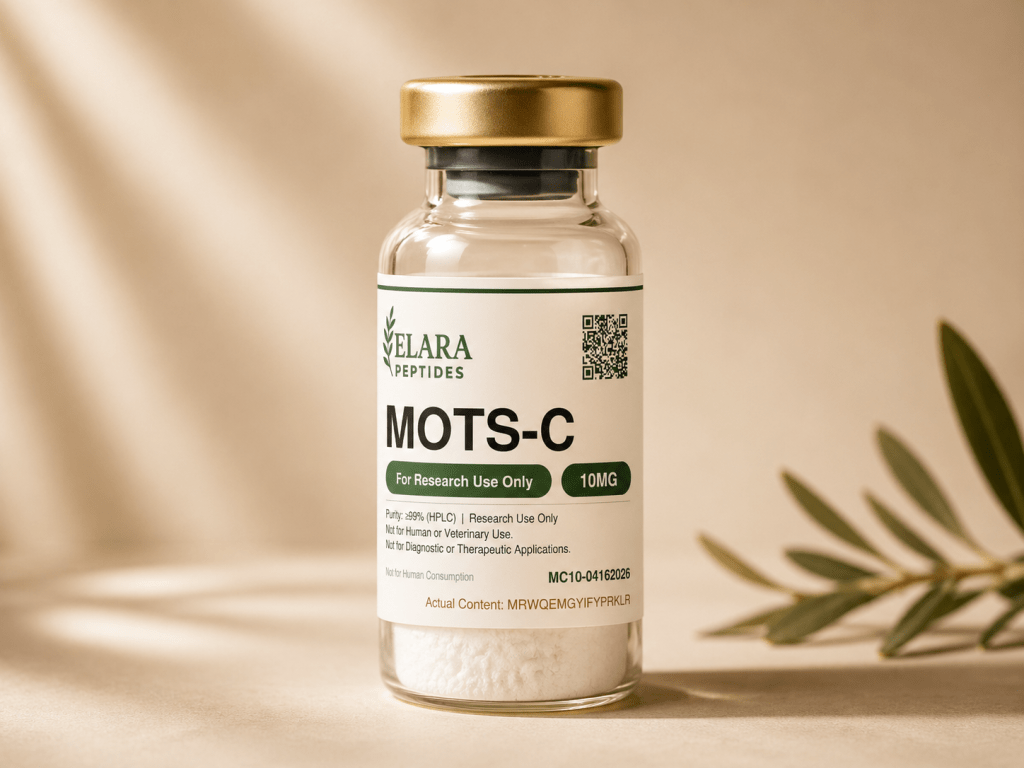
MOTS-c (Mitochondrial Open Reading frame of the 12S rRNA-c) is a 16-amino-acid peptide encoded within the mitochondrial DNA — making it one of the few known mitochondrial-derived peptides (MDPs) and a remarkable example of biological signaling originating outside the cell nucleus. It was discovered and characterized by researchers at the Buck Institute for Research on Aging and at the University of Southern California, with key publications by the laboratory of Dr. Pinchas Cohen establishing the compound's role in metabolic regulation. The "c" in MOTS-c refers to its origin in the 12S rRNA region of mitochondrial DNA. Endogenous MOTS-c levels in human plasma decline with age and with metabolic dysfunction, making the compound a focal point in research connecting mitochondrial biology to systemic metabolism and aging.
It is sold for laboratory and analytical research only and is not approved by the U.S. Food and Drug Administration for any therapeutic indication.
MOTS-c is a 16-amino-acid peptide with the sequence Met-Arg-Trp-Gln-Glu-Met-Gly-Tyr-Ile-Phe-Tyr-Pro-Arg-Lys-Leu-Arg (single-letter: MRWQEMGYIFYPRKLR). Its molecular formula is C102H152N28O22S2 with a molecular weight of approximately 2,174 Daltons. Notably, the peptide is encoded by the mitochondrial genome rather than the nuclear genome — a finding that fundamentally challenged the historical view of mitochondrial DNA as encoding only proteins involved in electron transport chain assembly.
The lyophilized (freeze-dried) form supplied for research is stable at -20°C for up to 24 months when sealed and protected from moisture. Following reconstitution with bacteriostatic water, the compound retains research-grade integrity for approximately 30 days when refrigerated at 2–8°C and protected from light. Repeated freeze-thaw cycles should be avoided to maintain experimental reproducibility.
MOTS-c functions as a metabolic regulator with effects spanning glucose homeostasis, exercise capacity, mitochondrial biology, and cellular signaling. Its mechanisms differ from the classical hormone systems and represent a relatively young research domain in human metabolic biology.
AMPK pathway activation. The most extensively documented mechanism for MOTS-c is activation of AMP-activated protein kinase (AMPK) — a master regulator of cellular energy homeostasis. AMPK activation drives glucose uptake, fatty acid oxidation, and mitochondrial biogenesis while suppressing energy-consuming pathways. AMPK is the same pathway activated by metformin (the most prescribed Type 2 diabetes medication globally) and by exercise, making MOTS-c research directly relevant to a major axis in human metabolic medicine.
Glucose homeostasis and insulin sensitivity. Research has documented MOTS-c-associated effects on glucose uptake, insulin sensitivity, and glucose disposal in human skeletal muscle cells and in animal models of insulin resistance. The mechanism appears to operate partly through AMPK-mediated GLUT4 translocation and partly through other glucose handling pathways. Type 2 diabetes affects approximately 38 million Americans, and the AMPK-glucose axis remains one of the most actively researched intervention points in human metabolic medicine.
Exercise mimetic effects. Research has examined MOTS-c as a potential "exercise mimetic" — a compound producing some of the metabolic adaptations associated with physical exercise. Endogenous MOTS-c levels increase with exercise in human subjects, and research has documented MOTS-c effects on metabolic and physical performance parameters in animal models that overlap with exercise-induced adaptations.
Mitochondrial biogenesis and function. Given its mitochondrial origin, MOTS-c has been studied for effects on mitochondrial number, function, and quality control mechanisms. Mitochondrial dysfunction is recognized as a hallmark of aging in human tissues and a contributor to multiple chronic diseases including diabetes, neurodegeneration, and sarcopenia.
Adipose tissue biology. Research has examined MOTS-c effects on adipocyte differentiation, fat accumulation, and metabolic activity in adipose tissue. Documented effects include reduced fat accumulation in dietary obesity models and altered adipocyte gene expression patterns relevant to metabolic disease research.
Bone and aging research. Emerging research has examined MOTS-c in bone metabolism contexts and in broader aging biology, where mitochondrial decline is recognized as a contributing factor to multiple age-associated phenotypes.
Cardiovascular and inflammatory pathways. Research has begun examining MOTS-c effects on vascular biology, inflammatory cytokine modulation, and cardiovascular metabolism, expanding the compound's relevance beyond pure metabolic regulation.
MOTS-c is a relatively young research compound — discovered in 2015 — and the human research literature is still developing. However, the published work to date establishes meaningful human-relevant findings.
Endogenous MOTS-c in human populations. Multiple published studies have measured endogenous MOTS-c levels in human plasma across age groups, metabolic status, and exercise context. The findings consistently show: declining MOTS-c levels with age, lower MOTS-c levels in subjects with insulin resistance and Type 2 diabetes, and elevated MOTS-c levels following exercise in healthy human subjects. These observations parallel patterns seen with other longevity-associated factors and have grounded subsequent translational research.
Human cell culture research. Research using human skeletal muscle cells, human adipocytes, and other human-derived cell systems has documented MOTS-c-associated effects on glucose uptake, AMPK activation, and metabolic gene expression. These cell culture findings provide the most direct evidence for how the compound interacts with human cellular machinery.
Clinical research status. Direct human clinical trials of exogenous MOTS-c administration are limited, with most translational evidence coming from animal models and cell culture work. Researchers should consult primary literature for the most current human clinical research status.
Translational research areas with substantial human clinical relevance:
MOTS-c represents one of the most novel research compounds in modern metabolic biology. The discovery that mitochondrial DNA encodes a peptide hormone with systemic effects fundamentally expanded the conceptual framework of cellular signaling and continues to drive research into other potential mitochondrial-derived peptides.
Every batch of MOTS-c supplied by Elara is independently analyzed by a third-party laboratory before release. Our Certificate of Analysis documents two distinct verification measures:
HPLC purity (≥99%). High-performance liquid chromatography separates the synthesized peptide from synthesis-related impurities, truncation sequences, and degradation products. Our specification requires a minimum 99% purity at the main peak, with documented retention time and peak area integration. MOTS-c contains two methionine residues that can undergo oxidation during synthesis or storage, and HPLC verification ensures the supplied compound has not undergone significant oxidative modification.
Mass spectrometry identity confirmation. MS analysis confirms that the molecular weight of the peak compound matches the theoretical molecular weight of MOTS-c (~2,174 Da), verifying both structural identity and the correct MRWQEMGYIFYPRKLR sequence.
The COA accompanies every shipment and is also available for download on this product page.
For laboratory research applications, MOTS-c is typically reconstituted using bacteriostatic water (0.9% benzyl alcohol). Standard practice involves slow addition of solvent along the inside wall of the vial — never directly onto the lyophilized powder, which can cause aggregation. The vial is then gently swirled (not shaken or vortexed) until the peptide is fully dissolved.
Once reconstituted, the solution should be stored at 2–8°C, protected from light, and used within 30 days for optimal molecular integrity. Sterile technique is essential during all handling steps. Researchers performing in vitro work or animal model studies should refer to their institution's IACUC protocols and standard handling guidelines specific to their experimental design.
What is MOTS-c?
MOTS-c is a 16-amino-acid peptide encoded by mitochondrial DNA, discovered in 2015 by researchers at the Buck Institute and USC. It functions as a metabolic regulator with effects on glucose homeostasis, insulin sensitivity, mitochondrial biology, and exercise capacity. The full name (Mitochondrial Open Reading frame of the 12S rRNA-c) reflects its origin in the 12S ribosomal RNA region of the mitochondrial genome.
What does MRWQEMGYIFYPRKLR mean?
That is the single-letter amino acid sequence of MOTS-c: Methionine (M), Arginine (R), Tryptophan (W), Glutamine (Q), Glutamic acid (E), Methionine (M), Glycine (G), Tyrosine (Y), Isoleucine (I), Phenylalanine (F), Tyrosine (Y), Proline (P), Arginine (R), Lysine (K), Leucine (L), Arginine (R). The "Actual Content" notation on the product label provides this sequence for verification by researchers familiar with the compound.
What does it mean that MOTS-c is mitochondrial-derived?
Mitochondria are the energy-producing organelles within cells. They have their own small DNA genome separate from the nuclear genome, historically thought to encode only proteins involved in electron transport chain assembly. The discovery that mitochondrial DNA also encodes peptide hormones with systemic effects (MOTS-c being the most studied example) fundamentally changed understanding of mitochondrial biology and opened the field of mitochondrial-derived peptides as a research category.
Has MOTS-c been studied in humans?
The human research is at a relatively early stage given MOTS-c was discovered only in 2015. Multiple published studies have examined endogenous MOTS-c levels in human populations across age, metabolic status, and exercise contexts. Human cell culture research has documented effects on glucose handling, AMPK activation, and metabolic gene expression. Direct human clinical trials of exogenous MOTS-c are limited and represent an active area of translational research.
How is MOTS-c different from compounds like metformin?
Metformin and MOTS-c both activate AMPK — the cellular energy sensor — but through different mechanisms. Metformin's AMPK activation appears to be primarily indirect, through effects on the mitochondrial electron transport chain. MOTS-c activates AMPK more directly through other intermediate signaling steps. The convergence on AMPK is the unifying mechanistic theme; the distinct upstream mechanisms are the subject of ongoing research.
What does HPLC ≥99% purity actually mean?
High-performance liquid chromatography is the analytical standard for assessing peptide purity. A specification of ≥99% indicates that, of all UV-detectable species in the analyzed sample, at least 99% of the integrated peak area corresponds to the target compound. For MOTS-c specifically, the two methionine residues require careful synthesis and storage to prevent oxidation, which would register as separate species and reduce the purity specification.
How long is MOTS-c stable after reconstitution?
Reconstituted MOTS-c retains research-grade integrity for approximately 30 days when stored refrigerated at 2–8°C and protected from light. Avoid freeze-thaw cycles. Lyophilized (unreconstituted) MOTS-c is stable at -20°C for up to 24 months when properly sealed.
What human pathways does MOTS-c research target?
The most-studied pathways with direct human clinical relevance include AMPK signaling (the cellular energy sensor central to glucose and lipid metabolism), glucose uptake and insulin sensitivity, mitochondrial biogenesis and quality control, exercise-induced metabolic adaptations, adipose tissue biology, and emerging research into broader aging-related metabolic decline.
Does Elara test every batch?
Yes. Every production batch of MOTS-c receives independent third-party HPLC and mass spectrometry analysis before release. Batches that do not meet our 99% purity specification are rejected. The COA documenting analytical results for the specific batch you receive is included with every shipment and available for download above.
| Purity | =99% (HPLC verified) |
| Form | Lyophilized (freeze-dried) powder |
| Testing | Independent HPLC, mass spectrometry, endotoxin |
| Documentation | Batch-matched Certificate of Analysis |
| SKU | MOTSC |
Proper storage is essential to maintain peptide integrity and maximize shelf life. Follow these guidelines for best results in your research workflow.
15% off · first order
Get 15% off your first order, plus batch notes and new-compound releases. No noise.
Research use only. Unsubscribe anytime.
You're in
Also sent to your inbox. Apply it at checkout.
WELCOME15

Reviews
There are no reviews yet.